Classification
Common Name: Syra (pl. Syrae)
Classification: Parasitic flyer
Known range: Later campaigns of the west; nesting reported in the Rainland
Threat Level: Extreme
Overview
Syrae are small flying predators that do not merely kill. They take a living or dead body and burrow their tails into the host's spinal cord to take control of the host's body. Settler-talk along the wet roads treats a clicking buzz in the canopy as a reason to freeze, then run. Public records class them among the extreme threats of the later age. Named hosts, and the full chain of command behind a swarm, remain sealed.
Appearance
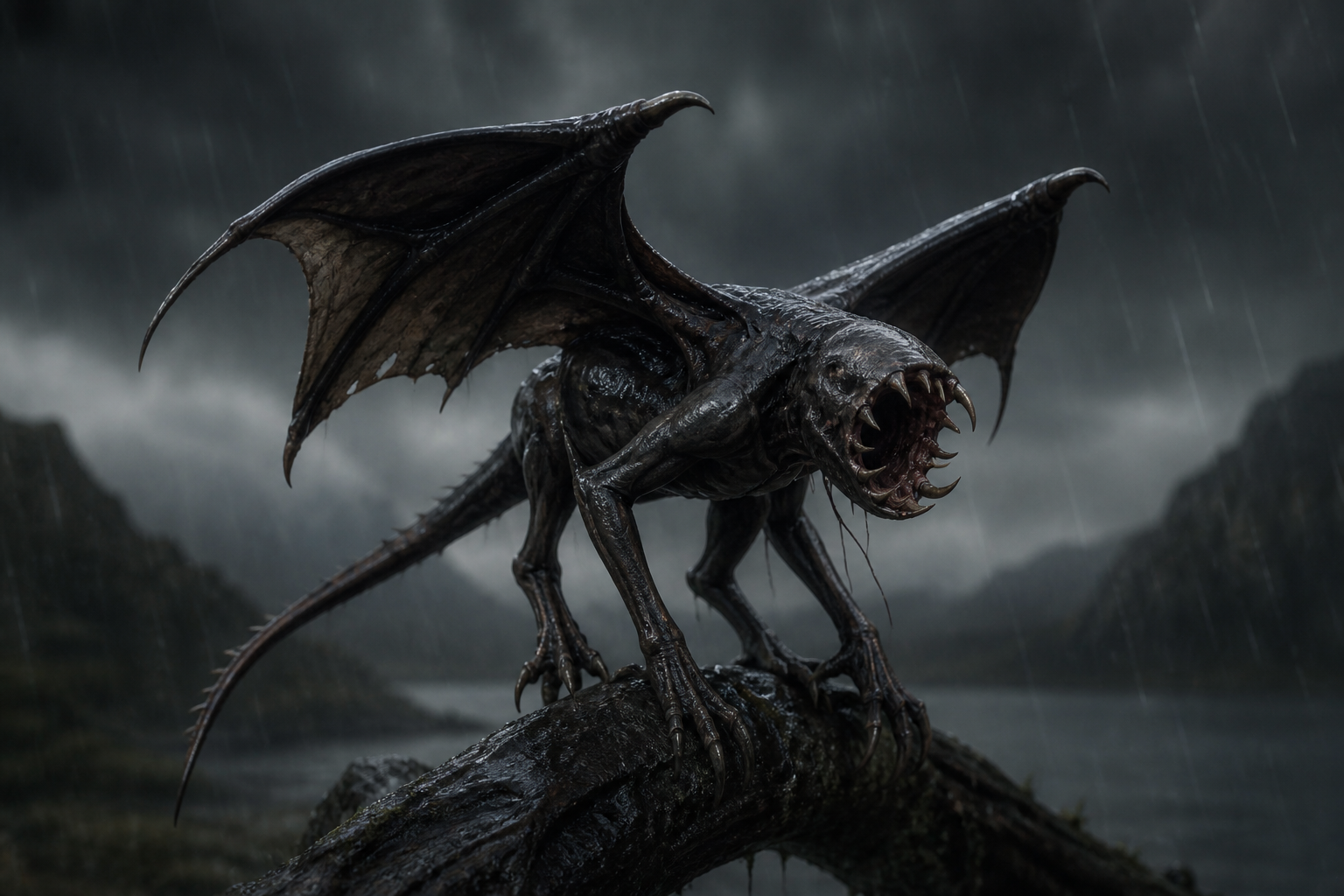
A Syra is compact and sinewy, with wet leathery skin, bat-like wings often torn at the edges, and powerful hind legs tipped with gripping claws. A long spear-tail ends in a hardened stinger. The jaws unhinge into a circular maw lined with inward-hooking teeth. Throat cords and a constant wet click or buzz mark mature specimens. No two field sketches agree on every spur and fold, but the circular mouth and spear-tail are constant.
Attack and Host-Taking
Witness accounts agree on a brutal order of work. The creature lands from behind, digs hind claws into the shoulders, drives the spear-tail into the spine, then opens the circular mouth against the skull. Soft tissue is drawn into the cavity. The Syra's internal organs are forced upward and into the skull cavity of the host for protection. What walks afterward is the host’s body under Syra control. Poison from the stinger can drop a victim before the feeding begins. Archivists note that some corpses have later been seen to move again under swarm influence. Named victims are not released for public circulation.
Lifecycle
First generation: Public chronicles place the first Syrae in the wake of an Angrodha whose life force was altered when it bit a living cocoon of vine and poison. The bite was meant as a killing stroke. Nature undercut the kill. Who raised that cocoon, and why the stroke failed as intended, remain sealed.
Reproduction: Afterward the swarm mates and breeds. Mating grounds, eggs, and young are named in later field notes. Metamorphosis from young to winged adult is recorded in the Rainland surveys.
Later range: A very few survived the great tower campaigns of the west. Scattered survivors settled nesting grounds in the Rainland before the latest age of the books. Exact campaign outcomes remain sealed.
Known Capabilities
- Powered flight on leathery wings
- Shoulder grip and spinal spear-tail strike
- Circular hook-teeth for cranial feeding
- Poison stinger capable of dropping prey
- Host body walked under Syra control after feeding
- Clicking and buzzing flight-call used for swarm coordination
- Reported animation of corpses under swarm influence
- Shared sight reported through a distant master — identity sealed
Signs of Presence
- Clicking or buzzing in wet canopy
- Leathery wing-shadows at dusk
- Hosts that walk wrong — shoulders high, head stiff
- Spear-tail wounds along the spine
- Circular bite marks about the skull
- Nesting smell in Rainland hollows after rain
Settler Lore
If the buzz is above you, don’t look up. Look for cover.
A man who walks with his shoulders wrong is already gone.
The first ones came from a dragon’s bite that should have killed — and didn’t.
Threat Assessment
Danger Level: Extreme
A lone Syra can take a trained fighter. A swarm can empty a road. Evacuation and fire are the only public responses named in the field guides. Origin particulars, named hosts, and the identity of any master that sees through their eyes remain sealed within the Restricted Archives of Moonledge Peak.
Related Entries
📜 Public Archive Record
This entry has been approved for unrestricted circulation within the Archives of Erathe.
Additional records concerning the Syrae remain sealed within the Restricted Archives of Moonledge Peak.